


San Francisco History Expo
Old San Francisco Mint
March 2-3, 2013


Photographs by Kathryn Doyle, San Francisco, CA, 3/3/2013.
Copyright © 2013 by Kathryn M. Doyle, California Genealogical Society and Library.

This blog is for and about the California Genealogical Society. We hope you will join us on our genealogy journey!
Recent Posts


 |
| Katherine Borges |
 |
| Tony Hoskins |

 |
| Jennie McCormick Firzgerald (1861–1935) |

A small bilingual traveling exhibit on the de Anza Expedition of 1775-1776 was on view at the City Hall in downtown Oakland. Organized by the National Parks Service and the Peralta Hacienda Historical Park, it also included a film screening of “The Anza Expedition” and a panel discussion by representatives of the Oakland Black Cowboy Association, the Peralta Hacienda Historical Park and the Juan Bautista de Anza National History Trail part of the National Park Service.
The De Anza Expedition led 240 men, women and children over 1200 miles and was intended to populate and colonize Alta California and establish a supply route between Sonora to the San Francisco Bay. The settlers founded San Francisco and San Jose. The De Anza National Heritage Trail extends from Nogales on the U.S. Mexico border through Southern California, through the Coast region to San Francisco. Native people guided the expedition over their trade routes comprised of trails and landscapes they knew for centuries. Profound changes ensued.
Eventually, the establishment of the Mission system destabilized and destroyed Native ways of life in California. Settlers and Native people interacted and intermarried to create a unique California culture.


The National Archives at San Francisco hosted a public Researcher Forum on Monday, January 28, 2013, at 4:00 p.m., with NARA Research Services Executive Bill Mayer from College Park, Maryland. Mayer oversees fifteen facilities of the National Archives nationwide, but this was his first visit to our regional facility in San Bruno.
The NARA forum was designed to gather feedback from researchers who visit the San Francisco facility on a regular basis. He came to answer questions and discuss issues related to the National Archives as a whole as well as to the San Francisco archive specifically.
Lavinia Schwarz and Judy Bodycote-Thomas represented the California Genealogical Society. Lavinia sent this report:
Judy Bodycote-Thomas and I attended the public researcher forum at the National Archives at San Francisco (which is actually in San Bruno) with Bill Mayer who was hired in May of 2012 as Executive of Research Services at NARA.
Mr. Mayer is traveling to meet and talk with researchers and constituents at all fifteen facilities of the National Archives nationwide. The Seattle-based manager of the western NARA facilities was also in attendance as well as the San Bruno staff and a variety of researchers and historians, individual writers including representatives of Angel Island, Chinese genealogists, and others. Judy and I were pleased to represent the CGS. Mr. Mayer began by thanking the staff for its good service and asking for our input on what we would like the future NARA to be.
Black and White vs. Color
He told us of ongoing discussions about color vs. black and white digitizations; whether old microfilm should be recopied; concerns about minimal handling of old documents; space limitation of the various facilities (Cape Canaveral data is now being transferred north). Attendees prefered color – especially for maps and building plans which are often color coded. We pointed out that the earlier black and white microfilming was done when color procedures were not yet available, but to fulfill NARA's goal of preserving documents we preferred the preservation of the original color as opposed to changing original documents to black and white.
One attendee asked if it is possible to digitize a front page with maximum information and indicate that a certain number of pages follow, e.g., an Angel Island file might have a name, date, photo, and say that the person's file consists of 30 more pages. Apparently, this would be quite hard as the information is dispersed throughout the file so creation of the front page would be labor intensive.
Another asked why the photos of Pearl Harbor, which used to be housed at San Bruno, have never been returned after they were borrowed while text documents have? Apparently all these docs were sent to Pearl Harbor at one point with the intention of their being returned for permanent housing at San Bruno, but the photos have been retained in a warehouse in Hawaii which is difficult for researchers to get access to. There was discussion of a trio of possible "owners" of the photos – The USS Arizona group, the US Navy, and the US Park Service. Without agreement among them, the photos have not been copied nor returned. This is an ongoing issue.
Another question was why are copies priced by the linear foot? Some maps, plans, Chinese scrolls, etc. are quite long. However, a flat fee, say $5 for simple text might suffice for other items. Mr. Mayer mentioned discussion of having researchers use NARA flash drives to make their copies, and those digitizations being added to the NARA files as they are made. This might be a way to expand the digitization process organically. We were amendable until he mentioned that we'd have to fill out forms as we made our copies. And there were questions about how labor intensive this would be for the staff each day to add the new digitizations to the database. Clearly NARA is trying to figure out how we can help them.
Mr. Mayer gave us his card and encouraged us to email him with specific suggestions. It was very good we were there.


Membership Coordinator Diana Edwards and Volunteer Coordinator Linda Okazaki are busy making plans for the April membership meeting. The theme will be: Preserving Your Genealogical Work through Publishing.
Members who have published genealogical books, articles, and other materials are invited to bring them to the meeting on Saturday, April 13, 2013. Please email Diana Edwards if you have a work to share. You will not be required to give a presentation.
In anticipation the meeting, we've added the new Books by CGS Members board to Pinterest.
We'll have more about the April meeting as the date approaches.
Copyright © 2013 by Kathryn M. Doyle, California Genealogical Society and Library.


The San Francisco History Expo brings local and neighborhood history groups together under one roof. This is an opportunity for people of all ages to learn about—and participate in—San Francisco history though presentations, photographs, artifacts, children’s activities, and historical reenactments.
The exhibits are all very interesting, covering many aspect of SF's past and present. Last year, the Maritime Museum exhibit was particularly noteworthy with a whole room full of items including a model ship with working rigging, and the parts labelled. It is also one of the few times when the mint is open to the public.Judy Bodycote and Nancy Servin are overseeing our presence this year. They are coordinating schedules for volunteers to staff our booth. If you can help, please email Nancy.

A half dozen or so San Franciscans interested in genealogy gathered at Dr. Edward Stephen Clark's office at 16 Geary. They pooled their knowledge of family history research and shared the materials they'd separately gathered. In fact, they held the first meeting of what would become the California Genealogical Society, the state's first organization of family history researchers.Dr. Edward Stephen Clark was elected the society's first president. Today President Jeffrey Valliant is the thirty-sixth to hold the office. Today we honor those who came before.
Dr. Edward Stevens Clark 1898–1900
Col. Adolphus S. Hubbard 1900
Mr. Herbert Folger 1901–1903
Mr. Zoeth A. Eldridge 1904
Mr. Herbert Folger 1905–1907
Mr. Orville Dwight Baldwin 1908–1909
Mr. Henry Byron Phillips 1912–1920
Mr. Delmar Leon Thornbury 1921
Mr. George Henry Andruss 1922
Dr. Charles Francis Griffin 1923–1931
Mr. George Arthur Merrill 1932
Mr. Charles Hancock 1933–1941
Mr. Robert T. C. Head 1942–1944
Miss Margaret Griffith 1945–1948
Mrs. Heward Armstrong 1948–1962
Mr. H. Lewis Mathewson 1963–1964
Mrs. Scott Rountree 1965–1970
Mrs. John Peirce 1971–1973
Dr. Albert Shumate 1974
Mr. J. Roger Jobson 1975–1976
Mrs. Charles C. Bowen 1977–1978
Mr. John Hale 1979–1982
Mrs. Constant Vaughn 1983
Mr. David Adams 1983–1977
Mrs. Jane Steiner 1987–1988
Mr. James Schuyler 1989
Mr. David Mason Adams 1990
Mrs. Mary Sweetman 1991
Mrs. Mary Lou Grossberg 1992–1993
Dr. Frederick S. Sherman 1994–1997
Mr. David Wilma 1998
Mr. Vernon A. Deubler 1998–2001
Mr. Glen S. Schimelpfenig 2001–2004
Mrs. Jane Knowles Lindsey 2004–2010
Dr. Stephen Harris 2010–2012
 |
| Dr. Robert Jackson |


Wednesday, March 20, 2013
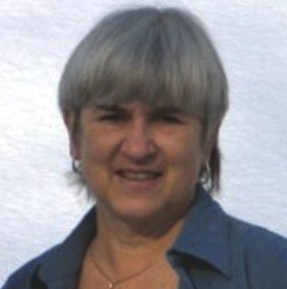
The February 2013 eNews, volume 7, number 2, has been published and emailed to members and friends. As always, the eNews features timely information about the California Genealogical Society and our upcoming events. Each edition also includes Suggested Links From the Blogosphere and a photo feature: California Ancestors. This month we honor Thelma Nordengen Armstrong Flaten, grandmother of California Genealogical Society board member Shannon Reese.
 |
| Thelma Nordengen Armstrong Flaten |


 |
| Thomas MacEntee, Lisa Gorrell, Cath Trindle, Linda Okazaki, Tim Cox, Eva Goodwin, Virginia Kysh and Julia Redford at SLIG 2013. (Not shown: Diana Powell) |
I had a great time at my second SLIG, meeting lots of people who do German research. Our class had several certified genealogists which added to the knowledge. We learned about German history and how important it is to know the history of your area. I was able to spend a couple of afternoons at the Family History Library and found an 1807 marriage record for my husband's Wollenweber line in Kusel and went back another generation!Tim Cox was enrolled in Course 9: Advanced Genealogical Methods coordinated by Thomas Jones, Ph.D., CG, CGL.
I was a little intimidated going in, but on Sunday night there was a get-together and I was chatting with a lovely woman only to discover she was my co-instructor! The rest of the week was a whirlwind of information. A high point for me was the reception and banquet on the last night. I spoke with Valerie Elkins who has been helping me with my Japanese research. She introduced me to Eric Stroschien, a professional genealogist with expertise in Japanese-American internment camp records. The timing couldn't have been better. I am eager to put into use all that I learned from the Sayres, then consult with Eric before heading to Washington, D.C. in February.The Utah Genealogical Association's Salt Lake Institute of Genealogy offers a full week of instruction by national experts. Students receive at least twenty hours of in-depth instruction. The 2014 lineup of courses has been published. It's not too early to start planning for next year!
Sandra Britt-Huber sent this report from the Saturday, Jan 19, 2013, meeting of the San Francisco Special Interest Group. Thanks, Sandra!
We had a great meeting, with twenty-three members in attendance. Ted Miles, reference librarian at the San Francisco Maritime Library and husband of volunteer extraordinaire Arlene Miles) presented a talk about San Francisco maritime records and history, focusing on the Pacific Maritime 1840 - 1900.
 |
Ted Miles and Lloyd's Register
|
Ted brought a volume of Lloyd's Register. Interest was high and Ted fielded lots of questions.
 |
| Lloyd's Register |
Ron Filion and Pam Storm did a presentation about shipping and maritime records at SFgenealogy.com. They also updated SIG members on what's new on their site: Holy Cross and Calvary Cemetary records are digitalized and the removals from Calvary to Holy Cross.

Lavinia Schwarz spent some time in San Diego this month and took the opportunity to visit with a local genealogical group. She attended Randy Seaver's regular second Wednesday meeting of the Chula Vista Genealogical Society.
It was terrific. Fifteen folks attended. I think their format would work well for some of our membership meetings at CGS.
 |
| Chula Vista Genealogical Society meeting of January 9, 2013. |
Randy had internet access and his computer was hooked up to a projector.
He started with a topic — this month a question: "What did you get for Christmas?" —and he went around the group for anyone who wanted to answer. Many passed. One brought a flip cam and did a quick demonstration; a few mentioned brilliant breakthroughs they'd had (one on Christmas Day after a phone call from a Rootsweb message board correspondent); and one who talked about finding his line back to Adam, which led to Randy's article My Purported Line Back to Adam and Eve – 140 Generations from Adam to Randy. This round robin took about forty minutes.
Next, Randy presented in detail what he had recently put on his blog about a few essential websites and some mapping. It was brilliant. I have in depth notes on that to share.
Last was another round robin. This time it was "Do you have a pesky problem? Let's ask the group for help." Among other things we found someone there who had not been able to find himself on the 1940 census. We failed at finding another one, but it was a terrific demonstration of wildcarding and trying various routes to circumvent poor indexing or spelling.
All in all, it was just great. The meetings are free for Chula Vista Society Members. As we said our goodbyes, Randy good-naturedly told me that facilitating the two hour sessions can be "like herding cats."

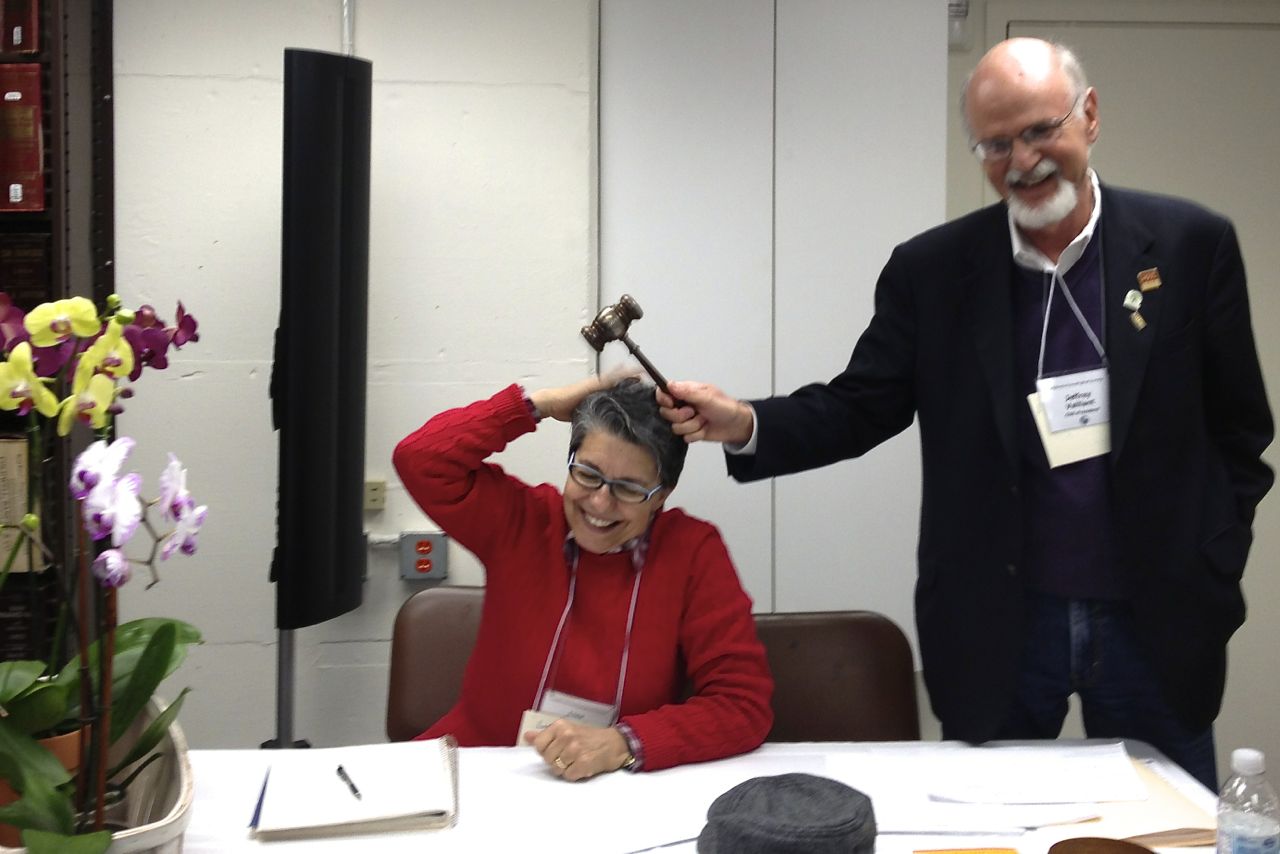
Arlene Miles sent this photo and question for our first blog contest!
Can you name the person who purple clogged our Annual Meeting?


The Annual Business Meeting of the California Genealogical Society was held on Saturday, January 12, 2013. A total of fifty-three members attended the festivities starting at 12:00 p.m. with a social hour in the Education Room organized by Diana Edwards and Linda Okazaki.




 |
| Clockwise from left: Linda Okazaki, Eva Goodwin, Lisa Gorrell, Tim Cox (not shown: Virginia Kysh and Thomas MacEntee) |


