California Genealogical Society: Blog

Recent Posts

22 April 2020

Quarantine Quests: A Lifetime of Postcards

Chris Pattillo is collecting "Quarantine Quests," stories of genealogical projects and discoveries made by our members while sheltering at home due to the global COVID-19 pandemic. This story was shared by CGS Board Member Arlene Miles.
Jamaica is one of the places in Long Island, New York that
Arlene Miles lived
I telephoned Arlene Miles, chair of the CGS Library Committee, a few days ago with a question about the library. While chatting I learned about Arlene’s Quarantine Quest project. After thinking about it for three or four years Arlene has now begun to scan her collection of postcards, partly because she now has extra time to do so.

The collection was started by her husband Ted – a regular visitor to the CGS Library. In his youth Ted had a vision problem that made it difficult for him to take photographs so his mother agreed to let Ted buy postcards of the places he visited and things he saw. Before he and Arlene married in 1984 Ted had already compiled a sizeable collection of postcards that reflect his life and his personal interests in trains, historic homes, streetcars, sailing ships, lighthouses and more.
Ted Miles's collection includes many historic buildings such as
the Wading River Congregational Church on Long Island, New York,
where he and Arlene were married
After Arlene and Ted were married the two of them continued the tradition and the collection has continued to grow. Now their two collections tell the story of their lives in postcards. Arlene has postcards from the schools she attended, from St. Francis de Sales Church where she was confirmed, and from St. John’s Church in Riverhead, New York, where she and Ted were married. They have post cards from their vacations and cards from every place they have ever lived. Arlene is considering starting a blog where she could use her postcards to illustrate her family history – “a picture is worth a thousand words.”

Arlene considered several scanner models before deciding on the Brother DS-720D, a small, compact unit that sells for $129 (she found one on sale for $109 at Office Max). “It is easy to use, will scan one or both sides, does full-color scanning and is self-feeding,” she says. She estimates that she can scan about 400 postcards in two hours. Images can be saved as either a PDF or JPG file.

The scanner comes with software that helps you organize, label and add information for each card. Arlene and Ted are maintaining the same organizational system that they created for the original cards – so they are grouped by subject matter. After the cards have been scanned Arlene uses Picasa software to crop, straighten, adjust the brightness, and make whatever adjustments are needed.


St John's Church in Riverhead, Long Island, New York
I asked Arlene, “How many have you finished scanning?” and was impressed when she said she had scanned about 1,600 postcards. But then I asked “How many cards do you have in your collection?” and I was truly speechless when I heard her answer. Arlene estimates they have 60,000 to 80,000 postcards in their combined collection! Hopefully the quarantine will not last long enough for the project to be finished. It seems Arlene is making good use of her at-home time while staying healthy.

The Miles collection includes postcards from 42 towns in
Long Island, New York
Copyright © 2020 by California Genealogical Society

19 April 2020

Online Genealogy: Week of April 19-26

Each week we will share news of upcoming online genealogy events. Most of them are free. Check our previous post “Genealogy Learning in theTime of Coronavirus” for a list of and links to free archived classes you can find online at Ancestry, FamilySearch, RootsTech, and more. 

Legacy Family Tree continues unlocking new webinars every day this month. This week:
The New York Genealogical & Biographical Society hosts 3 webinars this week:
FamilySearch hosts a daylong "English Research Seminar" in commemoration of St. George's Day, Thursday, April 23! Topics include:
  • A Researcher's View of Old English Life
  • England Non-Conformist Church Records
  • I Give and Bequeath: English Probate Records
  • Introduction to English Heraldry 
Your DNA Guide offers the free webinar "Understanding MyHeritage DNA" twice this week, on April 21 and April 23.

Conference Keeper keeps an up-to-date calendar of genealogy events from all over. Check their site for a list that includes many of the events mentioned above, plus some other gems that might be overlooked.

Don't forget to check the websites of your local genealogy and historical societies!

Copyright © 2020 by California Genealogical Society

17 April 2020

Quarantine Quests: Writing Leads To New Discoveries

Possibly the footstone at Hiram Gaines's grave
One of the inadvertent benefits of writing one’s family history is that sometimes the process leads to new discoveries. My current genealogical focus, during the CV-19 shutdown, is Hiram W. Gaines, a third-great-grandfather on my paternal line. I previously shared my story of how I was able to confirm the name of his father – that was the inspiration for this Quarantine Quests series.

I had been waiting to write Hiram’s biography for my family history blog until I could include the names of his parents. Since I now feel confident that I have that figured out, thanks to Ancestry’s ThruLines, I decided to write Hiram’s bio. That is what I’ve been working on for the last few days.

My process for writing an individual biography, once I have substantially completed researching that person, has two parts. I use the list of facts and the timeline features in my RootsMagic genealogy database to compose the narrative. Once that is complete I look through my source documents and select material to illustrate the post. Sometimes, particularly for more distant ancestors, I turn to Google to help embellish the story. After all, I want my siblings and cousins to read what I write so I try to make it as appealing as possible. For example, the list of possessions that were recorded in Hiram’s probate packet included a gig wheel, an inkstand and whip, and a flaxwheel and reel. I entered each of these in the Google search box and easily found images of all three to augment my story.
This image came up in Google when I entered Gig Wheel
I finished the text for Hiram’s bio yesterday afternoon. After dinner I was looking through the documentation I have for Hiram which includes a series of photos I took in 2017 of his original probate papers. Yes, the archive I visited in Abbeville, South Carolina allowed me to look for, handle, and make copies of Hiram’s material as well as the probate packets of several other Gaines relations.

While trying to decide which page of the probate packet to use as an illustration, a line item popped out at me and momentarily took my breath away. It simply read, “Monticello - .50”. Yes, this was a reference to the Monticello – the home of President Thomas Jefferson. Three years ago, I reviewed each item in his probate packet including this list of expenses and gave no thought to that specific entry; but recently I have done a lot more research on my Gaines line, and in doing so I learned that Humphrey Gaines was a carpenter at Monticello. Humphrey was Hiram’s uncle. Using good ol’ Google I found this website https://www.monticello.org/slavery/the-plantation/free-workers/ that lists Humphrey and two of his brothers as workmen who were employed at Monticello.
This is a page from Hiram's probate packet
showing the reference to Monticello

I doubt that there is any way of ever learning exactly what services or materials my third great grandfather sold to  Monticello but I believe this original record shows that there was a connection and that pleases me. Had I not endeavored to write a biography of this ancestor I would never have known this, but I did and now I do.

Let me know if you have a Quarantine Quests story. I’d like to hear from you. I will do the writing or edit what you write if you prefer. You can contact me at cpattillo@californiaancestors.org

Copyright © 2020 by California Genealogical Society

13 April 2020

Quarantine Quests: An Irish cousin provides vital clues

This Quarantine Quests story was shared by CGS Vice President Maureen Hanlon.

In August of 2015 Maureen made an Ancestry DNA connection with a fourth cousin, Michael Clarke. Michael lives in Warwickshire, England. He and Maureen share third-great-grandparents with the surname Reilly through their respective maternal lines.

As part of their initial correspondence Michael shared the research he’d done in south county Dublin – the area from which Maureen’s great-grandfather, Charles Downes, immigrated from in the 1860s. Most helpful was that Michael was able to provide the location of a cemetery and headstone with names and dates for three generations. This helped to confirm the critically important name of the townland where her ancestors had lived. But even with the new information neither Maureen or Michael could determine the first names of either of their third-great-grandparents. 
Chart showing the relationship between Maureen and her cousin Michael Clarke
Fast forward five years to March 2020, when Maureen found herself stuck at home because of the Covid-19 pandemic. “Seems like a good time to tackle this brick wall and see if I could find the elusive Reilly great-grandparents.” Back in 2015, Michael had pointed Maureen to the 1911 Ireland census, where she had found her grandmother’s Downes first cousins. Armed with this information Maureen was able to build a tree backward and connect those cousins to her grandfather’s siblings, parents and grandparents!

Now Maureen used that same 1911 census to identify the only Reilly family still in the same geographic area. Again she built a tree backwards, using civil records which cover 1864 onward. She used the free website https://www.irishgenealogy.ie/en/, which also holds the church records for Dublin. Once she had built this theoretical tree she sent it to cousin Michael seeking his opinion of her hypothesis.

Michael agreed that she was on the right track up to a point, but because of missing early records and the number of families in the area in those times with the same name, it was impossible to confirm Maureen's proposed tree.  The land records Michael had thoroughly reviewed were in conflict with Maureen’s thesis.  Michael believes that Maureen is probably missing a generation.
Saint Ann’s Cemetery, Glenasmole, Tallaght Civil Parish, Dublin, Ireland,
where Maureen’s third-great-grandparents Thomas and Honora Downes are buried

So this mystery is yet to be solved, but there is a silver lining. During their recent correspondence Michael, whose paternal line is also from the same area, shared, “a recent discovery with a new vocabulary word for me," Maureen said. A relative of Michael’s had found a letter dated October 1921, which revealed that Michael’s father was the company quartermaster of the Glenasmole IRA. According to the letter, Michael’s father had turned over custody of the parabellum (weapons) which were stashed in a secret cave to Thomas Downes, Maureen’s first cousin twice removed, proving that Maureen’s ancestors were actively engaged in the Irish fight for independence – new knowledge to embellish Maureen’s family history.


Copyright © 2020 by California Genealogical Society

09 April 2020

Quarantine Quests: Jim Sorenson Tackles His Maternal Grandfather

Chris Pattillo is interviewing our members about some of the genealogical projects they are working on while sheltering at home. This Quarantine Quest story was shared by CGS President Jim Sorenson.

Earl Morgan 1899
Like many of us, Jim’s interest in family history began with a school assignment. It was in the 1960s, when he was in 11th grade and one of his teachers asked each student to interview their oldest living relative and write about their heritage. At that time Jim’s mother’s mother and his father’s grandmother were still living, so he interviewed both of them and learned things about his family’s story that one would never find in written records. Jim still has his original notes from the class assignment.


In the back of his mind, Jim has thought, “Someday I’ll break my leg, I will be in a cast and unable to do anything–that is when I’ll tackle my writing.” Well, this is Jim’s break-a-leg event. If not now, while we are all housebound because of the Covid-19 shelter-in-place order, when?
Join the Break A Leg Club and write a bio for one of your Ancestors
So Jim has decided to write biographies for each of his four grandparents. He decided to start with his maternal grandfather, Earl Wright Morgan, whose work for the Standard Oil Company brought him from Pennsylvania across the country to California. During our interview, Jim shared several stories about Earl. I am not going to write about that because it is Jim’s story to tell, but I can tell you that when he is finished, it is going to be a fascinating read–something that deserves to be added to the Richmond History Museum and Standard Oil archives. Currently, Jim only plans to share Earl’s story with his family but I hope he will agree to have it published in the Nugget at some point.
Earl Morgan with his mother,  Julia Sweney Morgan, 1910
Over the years Jim has visited over 30 courthouses and at least that number of libraries to research his family and collect documentation that proves and expands upon the stories he has heard. He has done research in newspapers, city directories, at the Family History Center in Salt Lake City and of course, he has done a lot of research online and at the CGS library.

At this point, Jim has collected a lot of material about his ancestors. Originally, he made paper copies of everything he found. Jim explained, “I use to measure my research success by how many pieces of paper I had at the end of the day–one hundred pages was a real good day.” Now Jim is proud to say that for the past several years when he leaves Salt Lake City, he isn’t carrying paper copies – everything is digital on a thumb drive. Early on Jim decided on a file naming system that works well for him. Each document starts with the year, month and date. That way all his files are in chronological order. He has over 20,000 items in his family history files. He is still using an old version of Family Tree Maker from 2000 as his primary organizer for the information he has collected.

For many years Jim has been a member of our CGS Research Committee. He admits that he prefers to do research rather than write. But he wants to share what he has learned from his research with his family members. Like me, Jim has a small family–one living child and two grandchildren, who are only mildly interested in family history. Like me, we both write hoping that some future descendant will discover our writings and be thrilled to learn what we have to share. As of now much of what Jim has pieced together about his family is still in his head. He understands that he needs to get it written down so that others will not need to repeat the process he has gone through to find and put together the pieces of the puzzle.

While the process of researching has always been enjoyable, Jim has not gotten the same pleasure from writing. In recent years he has been doing more writing, including working on an article for The California Nugget. Jim shared that serving as president of CGS has actually helped in this regard. Having to communicate regularly with the CGS board and membership has caused Jim to do more writing and doing so has made him more comfortable with the process. 

Jim shared a tip for writers. He feels, and I think most would agree, that telling the story in chronological order is the best approach. But one should not feel bound to rigidly record every part of the story in precise chronological order. While Jim’s piece is about his grandfather Earl Morgan, for the story to make sense it needs to include information about Earl’s parents, and about his boss at Standard Oil. Jim does this by devoting separate paragraphs to each of these sidebar subjects. This is how “I try to contain the detours so they don’t break up the flow of the story,” says Jim. It works for him and may help others tell their family stories. 

If you have a Quarantine Quest story you'd like to share please get in touch with Chris Pattillo or Jennifer Dix.

Copyright © 2020 by California Genealogical Society

02 April 2020

Our first online class: "Blogging to share family history"

blog post image
A recent blog post by Chris Pattillo

We recently shared a list of online webinars and related genealogical activities that can be accessed from home. Now CGS is joining the online learning community with our first class: "Blogging to share family history" with Chris Pattillo on Thursday, April 9. This presentation is free to all.

Chris, who blogs about her family at Pattillo Thornally Ancestors, will talk about using the easy platform Blogger.com and offer tips and tricks for tackling family stories and putting them into words. The presentation starts at 10 am. If you join, please sign in by 9:45 to make sure you are able to see the program. We will send you a link the night before the class, which will get you right into our class.

To register and for more details, go to our EventBrite listing.


Copyright © 2020 by California Genealogical Society

01 April 2020

Quarantine Quests: A Hobby With Infinite Possibilities

Chris Pattillo writes:

It’s times like these when I most appreciate being interested in family history research because I can do it from anywhere and the possibilities of how to spend my time are infinite. Now that I have so much extra time while I shelter-at-home, it is nice to enjoy a hobby that keeps me engaged endlessly. There’s no fear of feeling lonely when I am able to find new ancestors and share my discoveries with my siblings and cousins.
From your Ancestry account, look for ThruLines
on the DNA tab, then select "Filters" to view matches.

Two days ago, I was poking around on my Ancestry account on the ThruLines page, which is under the DNA tab, and I noticed for the first time a button labeled “Filters.” I clicked on that and saw a category for “Potential Ancestors.” What I found when I clicked on that choice is something I’ve been pursuing fervently for the past three years – ever since I nailed down my third-great-grandparents Hiram W. Gaines and Hulda Waller, while I was on my 2017 Genealogy Journey and traveling in the Southern United States–South Carolina to be exact.

Ever since that find, I’ve been seeking Hiram’s parents. I have worked pretty hard on this. Various searches led me to well-documented trees for Hiram Gaines (1725-1805) married to Margaret Teliaferro (1775-1783), but no matter how hard I tried I could not prove a connection to this family. These trees included several Hiram Gaineses. As it's a somewhat unusual name, I felt certain this was my family, but I could find no proof and did find negative clues that showed that I was wrong. Has this ever happened to you?
This screenshot shows me with a DNA connection to William S. Gaines
But the beauty of DNA is that it does not lie. ThruLines told me I have a DNA connection to William Shanklin Gaines (1757-1851) and that he is my fourth-great-grandfather: the man I have most wanted to find for three years. As a bonus, it also showed a DNA connection to his father, Hiram T. Gaines, my fifth-great-grandfather! Needless to say, I was pretty excited to find this but before I shared my discovery with others I thought I should make sure it was right, so I called CGS member Vinnie Schwarz and asked her about it. She confirmed that I could trust ThruLines. This is something I appreciate about CGS. I am grateful to be able to reach out to other CGS members, who are more knowledgeable than I am, and to be able to ask for guidance and confirmation. It is one of the best and most valuable things about being a member of our society–especially at times like these.

Have you made any big discoveries while you have been staying at home? Let us know and we will share your story.

Copyright © 2020 by California Genealogical Society

COVID-19 update: Library closed through May 6, Salt Lake City trip canceled


President Jim Sorenson has issued this update:

"The closure of the CGS library has been extended through May 6. All CGS classes and events have been canceled through the end of May. However, we are working on having some classes conducted via remote access; the first of these will be on April 9. Among the events canceled are the CGS research trip to Salt Lake City. Refunds are being issued for all canceled classes and events. 

I'm sure everyone knows that the closure and cancellations are a dynamic process and we can not say for sure when CGS will be able to resume normal operations at either the CGS library or the Oakland FamilySearch Library. The health of our patrons and volunteers is of paramount importance to us."

 
Copyright © 2020 by California Genealogical Society

31 March 2020

The Census: It Ain't What it Used to Be

image: United States Census Bureau


Wednesday, April 1, is the deadline for all U.S. households to respond to the 2020 census.  If you somehow haven't gotten around to it, Uncle Sam will soon be in contact (though the current pandemic situation will have an impact on operations). Of course, you really want to respond to this once-in-a-decade survey, because it's essential to get an accurate count of residents in each of the 50 United States and its five territories: population determines how much funding local communities receive and how many seats each state gets in Congress.

It's super easy to fill out your census questionnaire this year: you can do it either online, by mail, or by phone. If you've already filled out your form, you probably noticed how short it is. The 2020 census consists of just 9 questions. It asks the name, sex, and birth date of every person in the household, whether the home is owned or rented, and the relationship of household members to one another. There are two questions about race and ethnicity: one for those of Hispanic, Latino, or Spanish origin, and another for all other races, with a subcategory for the respondent's self-identified ethnic origin(s). This is likely to produce a huge variety of responses. For a fascinating look at the country's history of recording race, see this article from the Pew Research Center: "The changing categories the U.S. census has used to measure race."

Genealogists who've scoured earlier censuses for clues to an ancestor's place of birth, education, occupation, or date of immigration may find the current census sadly lacking in detail. Genealogist Judy Russell recently mused about this in a post at her Legal Genealogist blog. In fact, this is nothing new: the 2010 census was similarly brief. The government ditched the long-form questionnaire after 2000, opting instead for the American Community Survey, which is sent out every year to a small percentage of the population. It's a safe bet that most of us who are counted in this year's census won't be around when those records are unsealed in 2092. By then, genealogists will surely rely on different sources and records for their research.

Copyright © 2020 by California Genealogical Society

25 March 2020

An Update from the CGS President


As most of you know, the CGS library has been closed since March 12 and we have canceled all public CGS activities through the end of April. Fortunately, many of our volunteers are able to work from home. The library closure and cancellation of classes may continue into May. Please check our website: https://www.californiaancestors.org/ for the current status. These are extraordinary times for CGS and this closure is unprecedented in the memory of any of us–but I’m sure you’re aware of why we have taken these steps. Due to the age demographic in the genealogy community, CGS will remain on the cautious side of any government mandates. Although I am not aware of any library or class attendees having tested positive for the coronavirus aka COVID-19, the threat is real and we are concerned for the health and safety of our patrons, friends and volunteers.

Individually, we will come through this and CGS will come through this. We are already planning the transition back to normal CGS operations on the other side although when that transition will start is unknown at this point. Rescheduling of canceled classes or events will have to be coordinated with the instructors and the calendar of events at each venue. We appreciate your support and understanding as we go down this road. The library closure will cause some disruption in our processing of membership dues renewals but we will not drop any members for non-payment of dues until the end of June. Rather than having individuals cancel their class registration, rest assured that all fees paid will be refunded for classes or events if they have been canceled.

I think most genealogists have tasks that have been put aside until someday when they have more time. Well, that time has come for many of us. It’s a good time to organize your family history files. I’ve started writing a narrative history for each of my grandparents based on years of accumulated information. And after that, I have to complete work on eight great-grandparents. Those narratives can be revised if new information is discovered but this is a great time to get started.

Jim Sorenson, President

Copyright © 2020 by California Genealogical Society

23 March 2020

Genealogy learning in the time of coronavirus

image: http://www.e-scheduler.com

While genealogy is often seen as a solitary pursuit, the abundance of conferences, classes, and other gatherings is evidence that we also work and learn together as a community. Although the coronavirus pandemic has disrupted many planned events this year, the virtual learning goes on. This is a great time to acquaint or re-acquaint yourself with the multitude of high-quality free webinars available to anyone with an Internet connection. While we can't list every single webinar, here are some good places to start:

Conference Keeper boasts "the most complete collection of genealogy events online!" This huge calendar advertises events from throughout the U.S., Canada, and sometimes other countries. New events are added often, so check the calendar frequently.

The New York Genealogical and Biographical Society hosts a multitude of webinars in March and April 2020. CGS past president Linda Harms Okazaki is speaking this Friday, March 27 on "A Japanese American Family from 1902-1992: Finding Records to Recreate the Hirai Family Story."

Ancestry Academy is a huge repository of free lectures and presentations on everything from beginning genealogy to understanding vital records to specialized courses on Mexican Civil Registrations, Quaker Research, common genealogy myths and so much more. The web videos range in length from a few minutes to an hour or more. Browse the collection here: https://www.ancestry.com/academy/courses/recommended

The Family History Library in Salt Lake City usually hosts weekly or monthly classes and webinars year-round. As with Ancestry, its collection is huge and topics are varied. While the library is temporarily closed due to the pandemic, live webinars continue through March; this week they include presentations on Germans from Russia, Irish ancestry, and descendancy research. All web classes are archived and accessible at FamilySearch.

The BYU Family History Library at Brigham Young University also hosts regular free webinars on various genealogical topics, and keeps them archived on their website so they can be watched any time.

RootsTech, possibly the largest annual genealogy conference in the world, makes its sessions available online during the event and keeps them viewable for free on its website afterwards. You can watch RootsTech sessions from 2015 through 2020 at their Video Archive.

Legacy Family Tree, partnering with MyHeritage, the Board for Certification of Genealogists, and other organizations, hosts free live webinars throughout the year, many led by some of the biggest names in genealogy. In the next few weeks, for example, Craig R. Scott speaks on "Using Fold3 to Your Advantage," Rick Sayre talks about "The General Land Office Website: A Genealogical Gem," and Rebecca Whitman Koford discusses the Maryland State Archives. Anyone may register and watch the live seminars for free, but you must pay an annual membership fee ($49.95) if you want to access instructors' notes or view the recorded sessions afterward. The Webinar Library does contain many archived recordings that are free to the public.

The Southern California Genealogical Society offers webcasts once or twice monthly, on a model similar to that of Legacy Family Tree, where anyone may register to watch the initial broadcast for free. You must be a member of SCGS to view the archived broadcasts. Next up: Julie Goucher talks about "Foundations to Researching in Europe" on April 4.

American Ancestors offers webinars (free) and many online classes (for a fee) throughout the year. The next free webinar is scheduled for April 30, when Curt DiCamillo presents "Treasures of the New England Historic and Genealogical Society." Learn more at https://www.americanancestors.org/education/learning-resources.

Copyright © 2020 by California Genealogical Society

18 March 2020

Update on CGS Library closure

Due to concerns about COVID 19, the CGS library will now be closed through at least April 15. All CGS classes and events have been canceled through the end of April (except for those held with remote conferencing). This closure and cancellation may be extended, so please check our website before visiting. Note that this also applies to classes scheduled at the Oakland Family Search Library: OFSL, as well as the Family Search Library in Salt Lake City, announced their closure on March 13 until further notice.

Copyright © 2020 by California Genealogical Society

16 March 2020

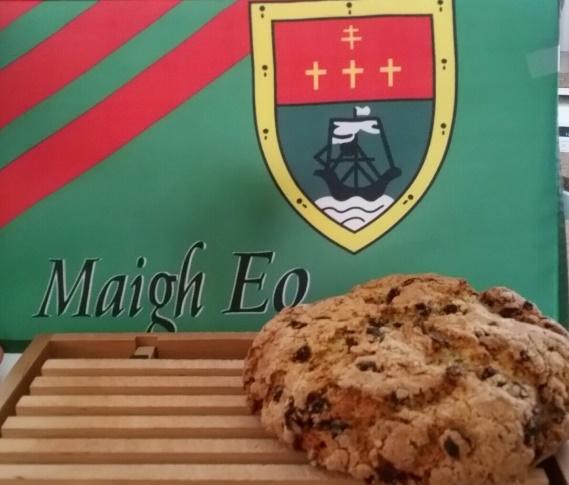
Happy St. Patrick's Day! Here's a recipe for Irish Soda Bread

Theresa Murphy shares this family tradition:

Irish soda bread and Mayo flag
Part of the fun in telling our family stories is sharing the recipes we cherish that bring us comfort and fond memories of our homes. My family and my husband’s both came from Ireland and at this time of year, I like to bake Irish soda bread as we celebrate St. Patrick’s Day. Especially now, as many of us are staying in to stay healthy, I thought it would be fun to share this recipe–a way to connect and something to try now that we have more time on our hands.

Now, having traveled in Ireland, I can tell you that there are as many soda bread recipes as there are townlands. This recipe has its roots in County Cork. My mother-in-law was the family historian and genealogist, and she both visited Ireland and stayed in touch with friends and relatives in Inchigeelagh, her father’s home, and Coolclogher, her grandmother’s birthplace.

Here’s the recipe for Mary Kearney Murphy’s Irish Soda BreadSlainté (to your health)!
 

Ingredients:
4 cups flour
1 Tbsp. baking soda
3 Tbsp. sugar
2 ½ tsp. salt
3 Tbsp. shortening
½ tsp. cream of tartar
1 ½ c. buttermilk
1 ½ cup raisins
2 Tbsp. caraway seeds

Preheat oven to 375 degrees F.
Combine dry ingredients, except raisins and caraway seeds. Cut in shortening. Add buttermilk, raisins, and caraway seeds. Mix well and knead on a floured board until smooth. Shape dough into a ball. Place on a buttered cookie sheet and flatten into a 7-inch circle. Cut a cross in the top with a floured knife. Bake 30-40 minutes. Cool completely before cutting.

Optional: Melt 1 Tbsp. butter and brush on top of loaf as soon as you take it from the oven. (I do not do this.)

If you have a favorite family recipe and a memory to go with it, why not share it? Email blog editor Jennifer Dix: jdix@californiaancestors.org

Copyright © 2020 by California Genealogical Society

13 March 2020

Now's Your Chance

CGS member Chris Pattillo writes:

For all our CGS members now is your chance to focus on that brick wall or organizing project that you’ve been putting off. What else are you going to do now that all the fun things you’ve planned are being canceled or postponed because of the coronavirus?

No more excuses that you don’t have time. Suddenly, time has been freed up. This may be a once-in-a-lifetime opportunity. As you cross out plans on your calendar because they’ve been canceled replace those notes with "Work on My Family History," or "Tackle That Brick Wall," or "Start Writing Now!"

Maybe you’ve been putting off a big organization project or avoiding facing a massive pile of filing. What about scanning all those photos? Well, now you have chucks of free time–the perfect time to tackle one of those boulders.


Above is a photo of my paternal grandmother Anna from the time when she lived with her older sister Kate in Rhyolite, Nevada. This is one of three photos that I described in detail on my family history blog for her biography.

Do you really want to start writing your family’s story but just don’t know how to start? Well, here is an idea–one that I’d planned to introduce during my blogging class that was scheduled for March 28 at the CGS Library but has now been postponed indefinitely. If you don’t think you can write, try this and see what happens: Find or buy some kind of audio recorder–I use an Olympus Digital Voice Recorder but a smart phone that takes voice messages will work. Even an old-fashioned reel-to-reel or a cassette recorder will work. Next find some old photos that show the person, family or event that you want to write about. Then pretend you are talking to someone from a future generation who will be thrilled to find what you wrote when they find it fifty years in the future. Turn on the recording device and simply describe what is in the photo. Tell a story about that person and some of the little things that you remember about them, or your parents or grandparents told you about them.

Here is another photo from the same time period. I used these to write about the individuals, and the setting-what the landscape looked like. I described the house in detail and even estimated its dimensions to explain how small the house was. I also pointed out the pet dog that appears in both photos.
Lots of people say they can’t write but I’ve never met anyone who said they can’t talk. So just talk normally and describe the person or event. Then play the recording back and type it up. That’s it, you’ve started writing your family history. Keep going–why not, what else have you got to do with all your free time? Oh, and forget about cleaning the garage.


Copyright © 2020 by California Genealogical Society

07 March 2020

COVID-19 announcement: CGS Library closed through March 28

Because of the uncertainty surrounding the spread of the novel coronavirus, we have decided to close the CGS Library until March 28. We prefer to exercise an abundance of caution rather than to potentially expose our volunteers and patrons to infection. At this time, classes held at the Oakland Family Search Library are not affected. We will refund all fees paid for canceled classes.

Given that this is a rapidly evolving situation, we will re-evaluate the state of affairs in two weeks.

For up-to-date information on COVID-19, it is recommended you consult one of the following websites:

Copyright © 2020 by California Genealogical Society

06 March 2020

Mountain View Cemetery Events - A Tour for Every Season

CGS members can join our "Naughty and Notorious Tour" of Mountain View Cemetery on March 21. You may not know, however, that this famed, park-like cemetery of 226 acres in North Oakland also offers free tours every second and fourth Saturday.

We just missed a Black History Tour that happened on February 22 but it is an annual event, so mark your calendar for next year.
One of the spectacular floral displays from a previous Tulip Festival

The weekend of March 27-29 is the 14th Annual Tulip Exhibit, which features spectacular floral arrangements created by Bay Area florists, garden clubs, and local college floral design classes. On March 28, Jane Leroe and Michael Colbruno will lead a tour for Women’s History Month, highlighting the lives of influential women such as Julia Morgan, Ina Coolbrith, and Anna Head.

April is when the cemetery hosts the Ching Ming Festival (remembrance of ancestors). This year, it is held April 4-5. On April 25, docent Chris Pattillo, a CGS board member, will lead a tour exploring the Trees of Mountain View Cemetery. 
Deodar Cedar at the Miller pyramid tomb on Millionaire's Row
at Mountain View
Local historian Dennis Evanosky gives a great tour following the Memorial Day Commemoration at the Civil War Plot on May 25. Jack London’s father is buried in the plot, as is Obediah Summers – an African American who served during the war. This tour starts after the commemoration event, at about 11 a.m.
Obediah Summers is buried in the Civil War Plot
Dennis also leads a June 27 tour about the California Gold Rush and Railroad.

This is just a smattering of the Mountain View offerings in 2020; other events include concerts, seasonal festivals, and more. Tours usually start at 10 a.m. and run about two hours. Plan to meet at the office just inside the cemetery gate. For complete details, visit their website: https://www.mountainviewcemetery.org/

Copyright © 2020 by California Genealogical Society

05 March 2020

"Paper Sons and Picture Brides" in NGS Magazine


Exciting news! The cover of the newly published January-March issue of NGS Magazine features an article by CGS members Grant Din and Linda Okazaki. "Paper Sons and Picture Brides" is an in-depth look at Record Group 85 found at the National Archives in San Francisco. This group of records, titled "Immigration Arrival Investigation Case Files, 1884-1944," contains information about immigrants to California during the late 19th and early 20th centuries. It is a particularly rich source for those researching their Chinese and Japanese ancestors, who often had to employ strategy to enter the U.S. at a time of heightened anti-Asian sentiment. Many prominent Asian Americans, from architect I. M. Pei to Congressman Norman Mineta, trace their ancestry to these early immigrants.

Beautifully illustrated with photographs and documents, Din's and Okazaki's article offers a broad historical overview that gives context to these documents. It also has a sidebar explaining how the activism of a group of genealogists and historians saved these files from destruction. The article includes anecdotes that show the sometimes grueling experience of Asian immigrants: an eight-year-old Chinese boy was grilled with more than 100 questions, including details of his village, house, school and neighbors, before he was allowed to join his father; a teenaged American citizen was detained for ten days upon returning to the U.S. from Japan. Din and Okazaki offer detailed information on how to access and interpret the files.

National Genealogical Society members can view the magazine online at the NGS website: https://www.ngsgenealogy.org/

Copyright © 2020 by California Genealogical Society

01 March 2020

March 2020 Events and Classes

Happy March! It's the month when we celebrate St. Patrick's Day, Women's History Month, and spring officially arrives on March 19 (a tad early this year). We have a lot of fun and educational events and classes coming up. If you see something that interests you and you haven't yet registered, please sign up!

Here's what's on tap this month:

March 18-April 8: Building Skills for Successful Family History Research, a four-week series taught by Pamela Brett, kicks off March 18 at the Oakland Family History Center. She shares "skills acquired from many years of beginner's mistakes." This is a great opportunity to tune up and sharpen your research skills with an experienced guide and fellow classmates.

Other happenings:

March 15: The Fifth Annual Irish Ancestry Network Meetup is a fun opportunity to network with others researching their Irish ancestors. Includes socializing, potluck lunch, and speakers TBA.

March 21: "The Naughty and Notorious Tour" of Mountain View Cemetery, led by docent Michael Colbruno. A special treat for CGS members.

Also March 21: West Coast Immigration in the 20th Century, a talk by Linda Okazaki, examines the ports of entry and the experiences of immigrants to the West Coast, many of them Asians, in the last century.

March 28: "Blogging to Share Your Family History" Chris Pattillo offers tips "for writers and non-writers" about starting your own genealogy blog.

Don't forget our monthly First Saturday "Intro to Genealogy" class, and our various Special Interest Groups!
All our events can be found listed on our website
Or at the CGS Facebook page
Or at EventBrite.com (search for "California Genealogical Society")


Copyright © 2020 by California Genealogical Society

24 February 2020

Results of the CGS Member Survey

image: Eventbrite

Late in the fall of 2019, we emailed a 26-question survey to our 880 members. We received 202 responses! Here are some of the things you told us:

Nearly half (47.8%) of the respondents rated their own genealogy skill level as Intermediate, while 20% rated themselves as Advanced, and 25% as Beginners. Two percent of the respondents were Certified Genealogists. About 75% said they belong to or participate in other genealogical societies, or regularly visit other libraries and archives.

We’re happy to know that 88% of respondents think CGS is offering classes that are of interest to them. Leading topics of interest were DNA (genetic genealogy), methodology, and technology, with a number who appreciated classes on particular countries or ethnic or geographical groups. Related to this were requests that the CGS Library carry more books on particular countries: at the top of the list was Britain, followed closely by Ireland, then Germany and related regions (such as Prussia and Pomerania). There also was considerable interest in Scotland, Canada, France, Italy, and the Baltic states.

Librarian Arlene Miles welcomes suggestions for new books
you'd like to see in the CGS library


Regarding the requests for books, CGS Librarian Arlene Miles would love to know what specific titles you’d like to see in the library. Please email her at amiles@californiaancestors.org.

While 63% of you feel it is very important that the society maintains its own library, slightly more than half (54%) would like more events to be held in different venues. The reasons for this varied, although many members live far enough from downtown Oakland that it is difficult for them to visit.

Many (68%) of you have a strong interest in seeing CGS offer online classes, live webinars, or posting recorded classes online. Our 2020 goal is to recruit volunteers with the necessary technical skills to set up and oversee this kind of a program.

We appreciate the feedback. CGS is continually striving to engage members by being responsive to their interests. The newly redesigned website includes a link where you can send us any comments or feedback on our programs and your needs.

Copyright © 2020 by California Genealogical Society

20 February 2020

Nichi Bei "Films of Remembrance," February 22 & 23

https://www.filmsofremembrance.org/


In the Japanese American community, February 19 is an annual "Day of Remembrance," marking the date in 1942 when President Franklin Roosevelt isssued Executive Order 9066, clearing the way for approximately 112,000 men, women, and children of Japanese ancestry to be evicted from their homes on the West Coast and held in American concentration camps and other confinement sites across the country. This weekend, the Nichi Bei Foundation hosts its 9th annual "Films of Remembrance," showcases of films commemorating the World War II incarceration of Japanese Americans. On Saturday, the festival screens in San Francisco's Japantown; the program repeats in San Jose on Sunday.

The San Francisco Chronicle offers an overview of the film festival. It includes 11 short films, discussion with filmmakers, local news personalities, a multimedia concert, and more.

The full schedule of events can be seen here.

Copyright © 2020 by California Genealogical Society