California Genealogical Society: Blog

Recent Posts

Showing posts with label Felicia Lowe. Show all posts

09 May 2020

Chinese Couplets: A daughter's long search for her immigrant mother's past

On Mother's Day, we are pleased to share this story by guest contributor Felicia Lowe.

I didn’t really know my mother.
She spent most of her life hiding who she was.
Lying about where she came from, how she got here.
What secrets were so dark that the truth had to be concealed?

These are the opening lines to my documentary “Chinese Couplets,” which explores the impact of the Chinese Exclusion Act (1882-1943) on four generations of women—my maternal grandmother, my mother, Lettie Kam, my daughter, Alana, and me. The story is shaped by my quest to unravel the mystery surrounding my mother’s origins, the revelation of her illegal immigration to America during the period of Chinese exclusion, and the resulting web of secrecy and shame underlying her assimilation and achievement of the American Dream. The journey takes us from contemporary San Francisco to 1930s rural China, across the world to pre-revolutionary Cuba, post-Mao rural China and again to California, a place on the cusp of its own revolution in multiculturalism.


Felicia Lowe's mother (center) as a baby,
with her mother and older sister.

The research was complicated and messy.  There was not a single source to gather the information I needed to formulate a picture of my mother’s journey to America. For one, she was a “paper daughter,” meaning she had assumed the identity of a child of a citizen, one of the few exempt classes allowed to enter the United States in 1937. For me, the intrigue began when I was three years old and my mom instructed, “If anyone asks where I come from, say Hawaii.”  I knew from my aunt, her older sister, that they were born in China so it was very confusing.

My mother maintained her “born in Hawaii” persona most of her life and refused to offer any explanation as to why her maiden surname was Kam (Kam Sau Quon) while her sister’s last name was Louie.  At the National Archives and Records Administration (NARA), Kam Sau Quon’s files revealed the story of a family with three young children who left Hawaii for China in 1924, then chose to return in 1937 as war was escalating in China. To learn of my mother’s early life, I read my aunt’s immigration transcripts.  She left China in 1931 in an arranged marriage so there was no subterfuge in her interrogation answers.

An ally in my investigation was my daughter, Alana.  She was able to break through her grandmother’s shell of secrecy by interviewing her for a school assignment. Out of it emerged a huge revelation.  My mother did not meet her father until he returned from Cuba when she was 15.  He’d left his pregnant wife and five-year-old daughter to find work there.  Chinese in Cuba?  That was new news to us.

Trips to Cuba and China followed in search of answers.  The most precious was a visit with my mother to Dutou, the village she’d left six decades earlier.  Like the Chinese couplet, a traditional poem consisting of two lines of verse held in contradictory and complementary balance, my family’s cross-generational tale encompasses a series of interlocked pairings: my mother’s secretive relationship to the past and the mother she left behind when she emigrated to America… my own fraught relationship with my mother… and my daughter Alana’s less-burdened curiosity about her Chinese ancestry and the bright hope it offers for healing the immigrant cycle of rupture, abandonment, denial and shame.

The turbulent times in which my mother came of age, the powerful challenges that all immigrants face, and the strength of the women, both my grandmother and mother, define my daughter and me.  It is their gift and our legacy–secrets and all.

Felicia Lowe is an award winning television producer, director, and writer with 40 years of production experience.  Her films “Chinese Couplets,” “Carved in Silence,” “Chinatown,” and “China: Land of My Father” have been broadcast on PBS and are used in classrooms across the country.  She’s long been associated with the Angel Island Immigration Station Foundation through her films and activism. www.lowedownproductions.com


Copyright © 2020 by California Genealogical Society

30 May 2018

Chinese Ancestry Day 2018


Chinese Ancestry Day,  held Saturday, May 26, at the Oakland Asian Cultural Center, was a fabulous success. CGS board member Chris Pattillo was among those who volunteered at the event, and she sent us this report: 

Next time you see Maureen Hanlon, make a point of thanking her for planning another tremendously successful CGS event!


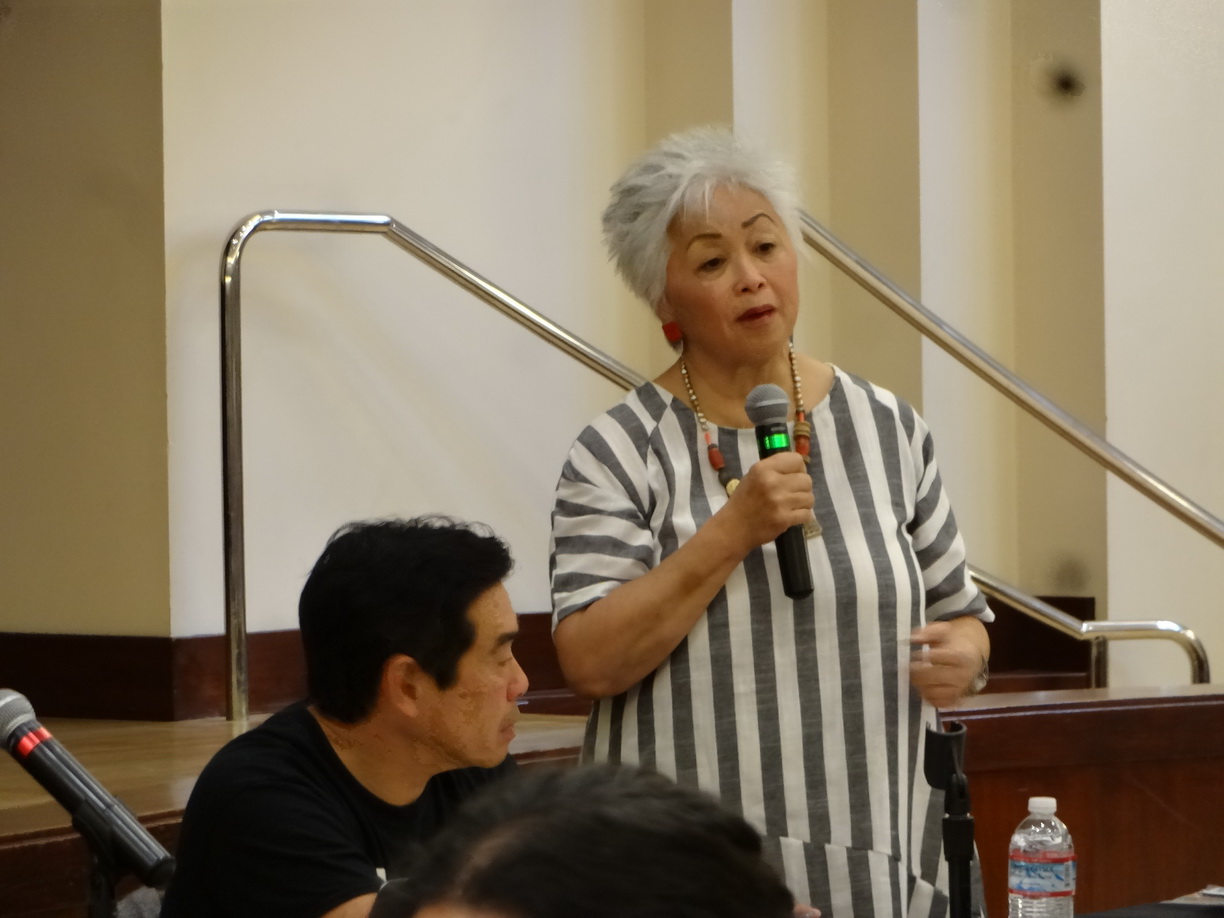
Speakers Grant Din and Felicia Lowe
Keynote speaker Felicia Lowe started the day with flair, showing an 18-minute clip of her documentary “Chinese Couplets”—just enough to leave us wanting to see the film in its entirety. Lowe’s journey to uncover her immigrant mother’s past was heartbreaking and heartwarming at the same time. It also introduced the day’s theme: the impact of the Chinese Exclusion Act on Asian American families to this day.

CGS member Grant Din gave a well-illustrated, clear and concise introduction to doing Chinese family history research. Grant is an engaging and exuberant speaker with 35 years of experience, and he shared ample anecdotes from his work.

We enjoyed lunch and socializing
The delicious lunch provided by Peony Restaurant was worth the price of the event on its own! There was plenty of food--even enough for seconds of yummy sesame balls.

After lunch we heard from Marisa Louie Lee, a former archivist at NARA. She served as an advisor on the PBS documentary “The Chinese Exclusion Act,” which aired this month. I was impressed with how easily Marisa moved between presenting and answering questions. She is a pro speaker. Marisa’s talk was also well illustrated, to the point and included a five-page handout with helpful information and links to other sources.

Finally, we heard from John Wong, a volunteer with the Roots Plus program who has led several tours for Chinese Americans to visit their ancestral villages in China’s Guangdong Province. John showed four videos that showcased the incredible experiences of four different families. The stories that John shared have universal appeal. No, I have no ancestors from China, but I still felt the shivers and warm glow these families experienced as they saw their ancestor’s graves and rural townships for the first time.

Much of the information being presented was not directly relevant to me personally, but I am so glad Maureen invited me to volunteer because I learned so much about things I knew nothing about. Do you know what a “paper mother” is? That is something I learned—if you weren’t there, you’ll just have to ask me.


CGS volunteers Kathryn Doyle and Linda Okazaki
It was apparent that a lot of productive networking was happening throughout the day. At our CGS table, we had two people join as new members and 18 added their names to our e-News list. Our table was next to that of the California Historical Society, where volunteer Frances Kaplan reported that she is grateful for CGS because she refers people with questions to us on a daily basis.

The event was sponsored by the Oakland Asian Cultural Center, California Genealogical Society, the California Historical Society, and the Angel Island Immigration Station Foundation. Our thanks to OACC for providing the beautiful venue and to OACC staff member Terri Kaley for being such a gracious host. 


Copyright © 2018 by California Genealogical Society

01 May 2018

Celebrating Asian American and Pacific Islander Heritage

Image: PBS SoCal
Happy May! Today is the first day of Asian American and Pacific Islander Heritage Month. We will be sharing articles and events celebrating the contributions of Asian Americans and Pacific Islander Americans throughout the month. The month of May was chosen to commemorate the immigration of the first Japanese to the United States on May 7, 1843, and to mark the anniversary of the completion of the transcontinental railroad on May 10, 1869, since a majority of the workers who laid the tracks were Chinese immigrants.

Of special interest to California Bay Area residents is the upcoming Chinese Ancestry Day, held Saturday, May 26 at the Oakland Asian Cultural Center in Oakland's Chinatown. The daylong workshop covers the fundamentals of genealogy for Chinese American families, offering basic steps to build your Chinese family tree.

Four distinguished guests will speak at the event, sharing their different areas of expertise. Keynote speaker is filmmaker Felicia Lowe, an award-winning independent television producer and director who is a Bay Area native and descendant of Angel Island detainees. Lowe will screen excerpts from her latest documentary, “Chinese Couplets,” which she describes as part memoir, part history, and part investigation. It explores the impact of the Chinese Exclusion Acts on four generations of women in her family. “What motivated me first of all was I really didn’t know my mother. I didn’t know her past,” she says. “Although I’m American born, I felt robbed of a history.” Her parents, both immigrants, were very reluctant to talk about their lives in China or the experience of coming to America. “The other compelling reason was that as long as there was the silence, the secrets, Exclusion still had a hold on my family," Lowe says. "And by telling it, I broke that hold.”

Genealogist Marisa Louie Lee will speak about “Chinese Exclusion Act Records at the National Archives.” A former archivist at the National Archives at San Francisco (in San Bruno), she is experienced in finding and interpreting records of Chinese and other Asian peoples who came to America during the Exclusion era, when they could not legally become citizens. Their stories, she says, are a part of American history that has long been overlooked. Lee was a research consultant on the documentary “The Chinese Exclusion Act,” which premieres May 26 on PBS as part of The American Experience series. “Does every fifth grader learn about the Exclusion Act in school?” she asks. “I’m hoping the film will help move that story into the mainstream.” 

Grant Din, an experienced researcher and genealogist, will speak on “The Importance of Family Stories.” And John Wong of RootsPlus will discuss “A Pilgrimage to Your Ancestral Village.”

The event concludes with time for questions and discussion, followed by lunch at the Peony Restaurant. For more details or to register, click HERE.

Chinese Ancestry Day is sponsored by the Oakland Asian Cultural Center, California Genealogical Society, the California Historical Society, and the Angel Island Immigration Station Foundation.

Copyright © 2018 by California Genealogical Society